
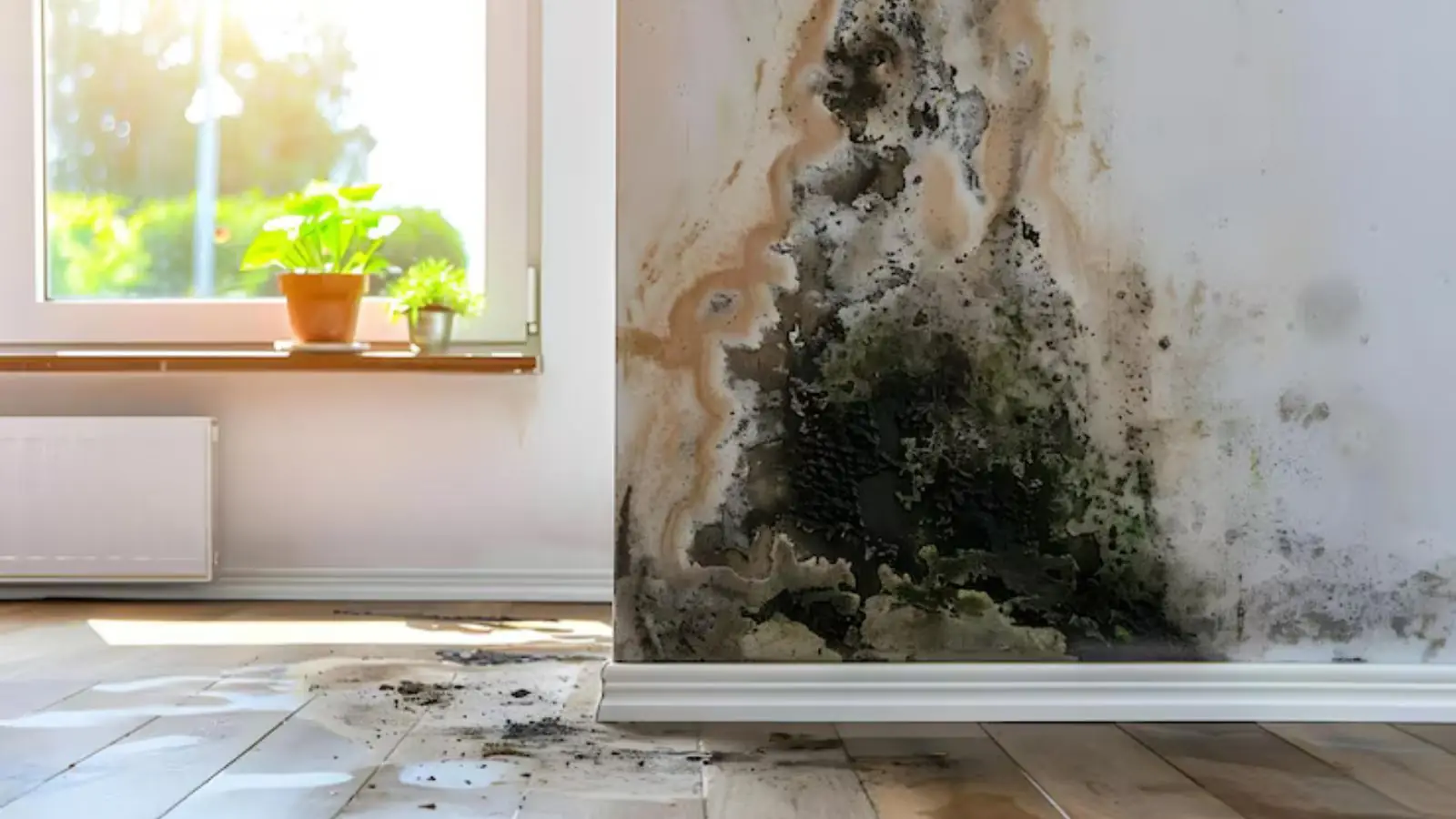
What this page will not do
It will not diagnose anything or make health claims. Color does not identify a type of mold. Only laboratory analysis of a sample can name what is growing, and questions about how it affects any person belong to a physician.
The words black mold carry a lot of fear. In practice, growth that looks black, green, gray or brown can be several different organisms, and two samples that look identical can differ. A dark patch also might not be mold at all. So the useful questions are practical ones. Where is the moisture, how big is the area, and what is the right way to deal with it?
Where dark growth tends to show up
Shower and tub corners
Caulk lines, grout and the base of a glass door stay damp after every use. Dark spotting here is often the first thing people notice.
Behind furniture
A couch or dresser pushed against an exterior wall blocks airflow. The wall stays cooler and slightly damp, and growth can appear on the back panel or paint.
Closets with a past leak
A closet that once got wet from a pipe or a roof leak can hold moisture in drywall and carpet for a long time. Spots on a closet wall are a classic sign.
Attics and patio structures
Bird droppings and mold show up together on wood in attics and patio covers. Poor ventilation and a roof leak both contribute.
Under sinks and around toilets
A slow drip at a supply line or trap keeps the cabinet floor damp. Look behind the stored items, not just at the front.
Every item on that list has the same ingredient in common. Mold needs moisture. Without water, a spot does not spread. With a persistent source, cleaning it only buys time.
Mold, mildew or dirt?
| Clue | Looks like | Quick check | What it suggests |
|---|---|---|---|
| Dirt or soot | Smudged, wipes cleanly, no pattern | Dry cloth removes most of it | Surface grime, often near vents or edges |
| Mildew | Flat, powdery, white to gray on a surface | Wipes away, returns in damp spots | Surface growth with a humidity cause |
| Mold | Fuzzy, spotted or patchy, often with a musty smell | Smears, comes back, may sit in a patch of damp material | Growth tied to a water source, may go deeper |
| Stain from old water | Brown or tan ring, no texture | Dry and unchanging | A past leak that has dried |
| Efflorescence | White crust on concrete or masonry | Dissolves in water | Mineral salts, not growth |
The table is a guide for sorting what you see, not a lab result. If a spot keeps coming back after you wipe it, or sits on drywall that feels damp, treat it as moisture-related until shown otherwise.
Dark growth after a leak or flood?
Call and describe the room. Same-day response when available.
Testing versus a visual assessment
A visual assessment is a trained person looking at the area, using a moisture meter and a thermal imaging camera to map damp cavities, and tracing the water. It answers where the problem is and how big it looks. It does not name a species.
Testing takes samples, such as an air sample or a surface swab, which a laboratory analyzes. It can document what is present at a point in time. Results depend on where and when you sample, so one test is rarely the full picture. Some buyers and lenders ask for it before a sale, and clearance testing after remediation shows the work met its target.
Ask whether your state licenses mold work, and who is doing the testing. Remediation and testing follow ANSI/IICRC S520 practice, and you can ask any company whether its crews work to it.
What to do, and what to skip
Find the moisture
Check the nearest pipe, drain, roof edge, window or condensate line. Stop the source before anything else.
Photograph and note it
Take wide and close photos with a date. Record when you first noticed it and any past leaks.
Limit disturbance
Keep fans off pointed at the area, and keep children and pets out while you wait. Moving the growth around spreads it.
Get it assessed
For anything larger than a small surface spot, or any area on drywall, carpet or insulation, ask for a written scope.
Dry, then clean or remove
Porous materials that grew mold are usually removed. Solid framing is cleaned. Fix the water source first, then dry the cavity.
- Do not paint or caulk over growth to hide it.
- Do not scrub dry drywall with a brush, since it releases material into the air.
- Do not mix bleach with other cleaners.
- Do not run a fan across the area before it is assessed.
Small, surface-only spots on a hard, non-porous surface, like a tile corner, are often handled by the household with ordinary cleaning and better ventilation. Larger areas, repeated returns and anything on soft materials call for a professional scope. Our mold remediation service starts with the moisture map and a written scope, and no mold work is done before the water source is dealt with.
If the cause was a plumbing event, the drying stage comes first, and water mitigation removes the moisture that growth depends on. Nobody can promise mold never returns, which is why moisture control is the point of the job.
Neighbors asking the same thing
Homeowners in Thousand Oaks and Westlake Village run into the same shower corners and closet walls, and the same rule applies. Find the water, document what you see, and get a written scope.
Newbury Park water and weather notes
Southern California summers are warm and dry, so it is easy to assume mold cannot take hold here. The Thousand Oaks area still averages 17.35 inches of precipitation a year, mostly in the cool rainy winters. The cause is rarely the air. Bathrooms, closets with a past leak and roof penetrations stay damp in any climate, so check those spots after the first winter storms.
During the Woolsey and Hill fires that began November 8, 2018, most of Newbury Park was evacuated for two to three days. A house left closed up with a slow leak under a sink or a wet closet can develop a musty smell by the time people return. If that applies to you, check under sinks and in closets and look for dark spotting before it spreads.
For repairs that involve a water heater, plumbing fixtures or water and sewer lines, the City of Thousand Oaks lists permit requirements and schedules inspections through TO/24. Call the Building contact at (805) 449-2320 before repair work, because permit rules vary by scope.
Sources: Wikipedia, NOAA normals via Wikipedia, City of Thousand Oaks website
Frequently asked questions
Is black mold more dangerous than other mold?
This page cannot say. Color does not identify a mold type, and health questions belong to a physician. What we can say is that any growth means moisture, and that moisture needs to be fixed.
If you are worried about how it affects someone in your home, ask a doctor.
Can I tell what kind of mold it is by looking?
No. Different organisms can look alike, and one species can look different in different conditions. Only laboratory analysis of a sample can identify it.
Do I need a mold test?
Not always. Many jobs are scoped from a visual assessment and moisture mapping. Testing helps when documentation is needed, such as before a sale or for clearance after work.
Ask whether your state licenses mold work, and who performs the testing.
How do I stop mold from coming back?
Nobody can promise it will not. What you can do is control moisture. Repair leaks fast, run bath fans, dry wet items within a day or two, and keep furniture a few inches off exterior walls.
I came back after the 2018 evacuation to a musty closet. What should I check?
Start with the closet's neighbors: the nearest pipe, the roof above it and any window. A closet that stayed closed with a slow leak can hold moisture in drywall and carpet.
Photograph it, note when you first noticed the smell, and get a written scope for any area on soft materials.