
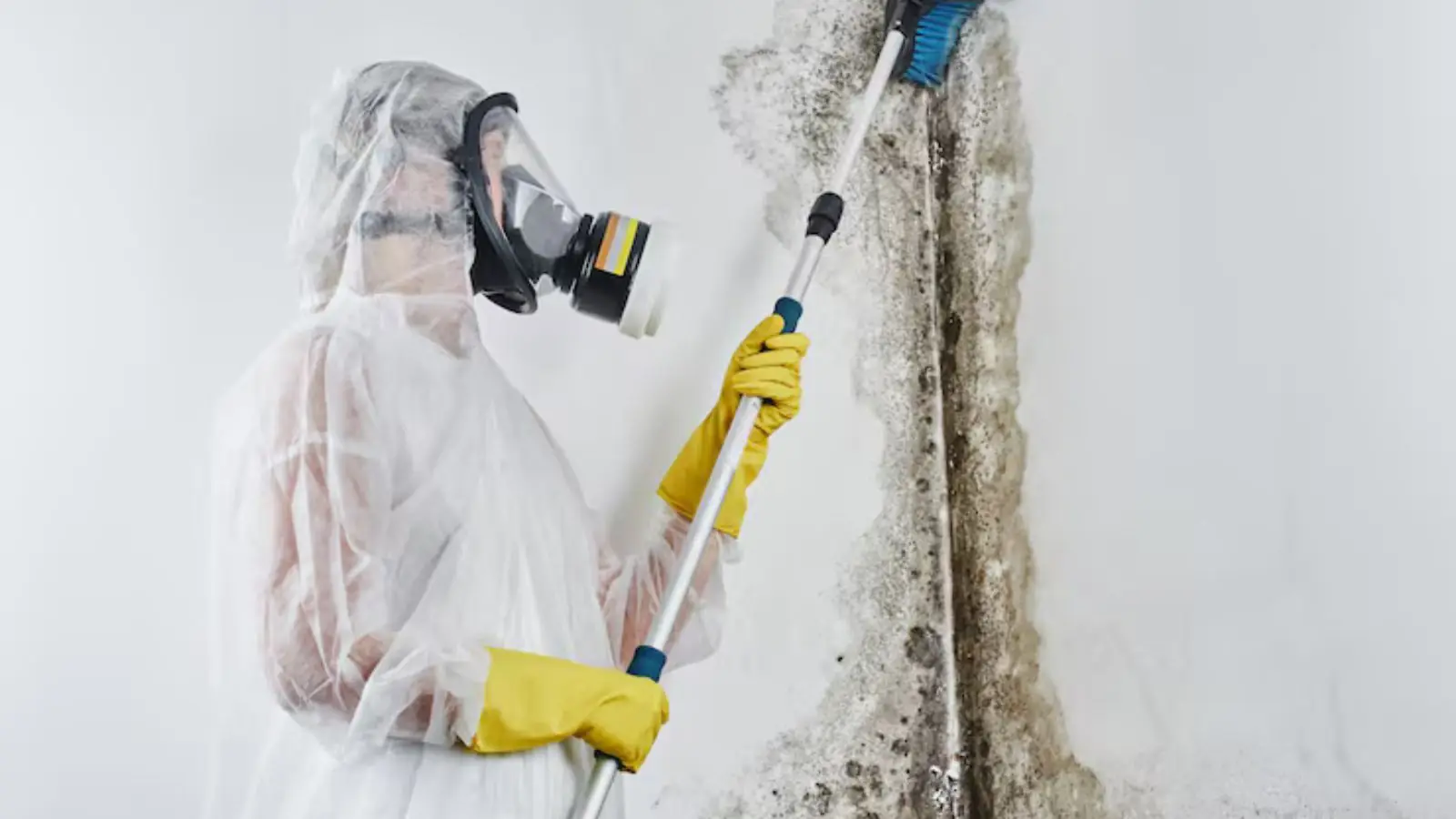
Mold remediation in Newbury Park, CA is the process of containing and removing mold growth from a home after moisture lets it take hold. The work follows the published ANSI/IICRC S520 standard for mold remediation, and you can ask any company whether its crews work to it. It always starts by finding and fixing the water.
Spots, a musty smell or a stain that keeps coming back?
Few people search for remediation first. They search for mold in a bathroom corner, a patch behind a dresser, a closet wall with a past leak or a musty smell that will not clear. Those are the usual signs that moisture is still in the building materials.
Painting or wiping the surface does not solve it, because the growth is fed from behind. A visit to look at the area and take moisture readings tells you what is going on. Call to describe what you see.
Shower and bathroom corners
Growth at the wall and ceiling joint near a shower often points to steam, a weak seal or a slow leak.
Closets with a past leak
A wet spot on a closet wall or carpet can sit unnoticed for weeks behind clothes and boxes.
Behind furniture
Furniture pushed against an exterior wall traps air and moisture, so spots show when it is moved.
Ceilings and attics
Roof leaks and air handler condensate lines are common sources, and the stain may be above the room.
Mold testing and inspection
Many callers start by asking for a mold test or an inspection. An inspection looks at the area, takes moisture readings and finds the source of the water. Testing samples the air or a surface, and the lab results show what is present. Testing does not replace finding the moisture.
Assessment comes first, before anything is removed. Independent clearance testing, done by a party that is not doing the remediation, is the check at the end. Ask whether your state licenses mold work, and ask each company who does the testing.
Real estate adds another reason to test. A buyer's lender or escrow officer sometimes asks for clearance testing before closing. That is a fact about how sales work, not a promise about what any lender will accept, so ask the lender what it needs.
Need someone to look at it?
Describe the spot and where the water might have come from. The line is open 24/7.
How remediation works
Find and stop the water
The leak, condensation or humidity source is fixed first. Without that, growth returns to the same place.
Contain the area
Plastic sheeting seals the work zone, and negative air machines with HEPA filters keep spores from moving to the rest of the house.
Remove and clean
Porous materials with growth, like drywall and insulation, are bagged and removed. Framing and hard surfaces are cleaned.
Dry and verify
The area is dried to a dry reading, and a post-work check confirms the result. Rebuild follows.
Mold removal and black mold cleanup
Mold removal covers the physical work of taking affected material out. Black-looking growth gets a lot of attention, but color alone does not identify what kind of mold it is. Testing and a lab report do. For homeowners, the practical steps are the same: contain, remove, clean and dry.
We do not make health claims about mold or diagnose symptoms. Questions about health belong to your physician. What we can tell you is what is growing where, what has to come out and how to keep the work contained.
Cleanup details matter. Dry brushing or sanding a moldy surface sends spores into the air, so removal is done with the area sealed, with HEPA vacuums and damp wiping. Materials come out in sealed bags so they do not drag growth through the house, and the work zone stays under negative air until the cleaning is finished.
Mold after water damage
Mold can start after water has been present for a couple of days, which is why quick drying matters. If you had a leak that was not dried properly, mold may be hiding behind walls or under carpet. Water mitigation is the way to dry the structure quickly, and the rebuild afterward is under water damage repair.
Call data from homeowners shows the same pattern again and again. A toilet supply line leaks upstairs and spots appear on a finished ceiling below. A condensate line backs up and a closet wall stays damp. A roof leak soaks insulation that nobody sees. In every case the answer begins with stopping the source and drying, then deciding what has to be removed.
Remodeling uncovers growth too. A homeowner gutting a wall or pulling up carpet may find a hidden patch, and the safe move is to stop work, keep the area closed and get it looked at before demolition spreads it.
| Material | If it has growth | Why |
|---|---|---|
| Drywall | Usually removed | Paper and gypsum are porous and hold growth below the surface |
| Insulation | Usually removed | It cannot be cleaned well once wet |
| Wood framing | Usually cleaned and dried | Solid wood can be cleaned and dried to a dry reading |
| Carpet and pad | Usually removed | Fibers and pad are porous |
| Tile and sealed surfaces | Usually cleaned | Non-porous surfaces clean well |
What affects the cost
Scope drives the price: the size of the affected area, the materials involved, access (an attic or crawl space is harder), the containment needed, testing and clearance, and the rebuild afterward. Scope and price are explained before work starts. Insurance varies, so check your policy or ask your insurer. Want your real number? Call (805) 291-8940.
Local notes for Newbury Park
Mold needs moisture, and in Newbury Park the common sources are roof leaks in the rainy season, bathroom humidity and plumbing leaks. Rebuild work may need a permit depending on scope, so ask the City of Thousand Oaks building division at (805) 449-2320 before you start. We also serve Westlake Village just up the corridor.
Frequently asked questions
How do I know if it is mold?
Color and texture do not confirm it. A visual assessment with moisture readings, and a lab test if needed, tells you what is present and where the moisture is coming from.
Do you test for mold?
Assessment and testing are part of the process. Independent clearance testing, done by a party that is not doing the remediation, is the final check.
Will a buyer's lender need mold clearance?
Sometimes a lender or escrow officer asks for clearance testing before closing. Ask the lender what it needs, and keep the written report.
Can I just clean mold with bleach?
Surface cleaning does not fix the moisture and rarely reaches growth in porous materials like drywall. Find the water source first, then remove and clean in containment.
Does your state license mold work?
Ask whether your state licenses mold work, and ask each company what it can show you about the crews doing the job. Credentials are between you and the company you hire, so ask before signing.