
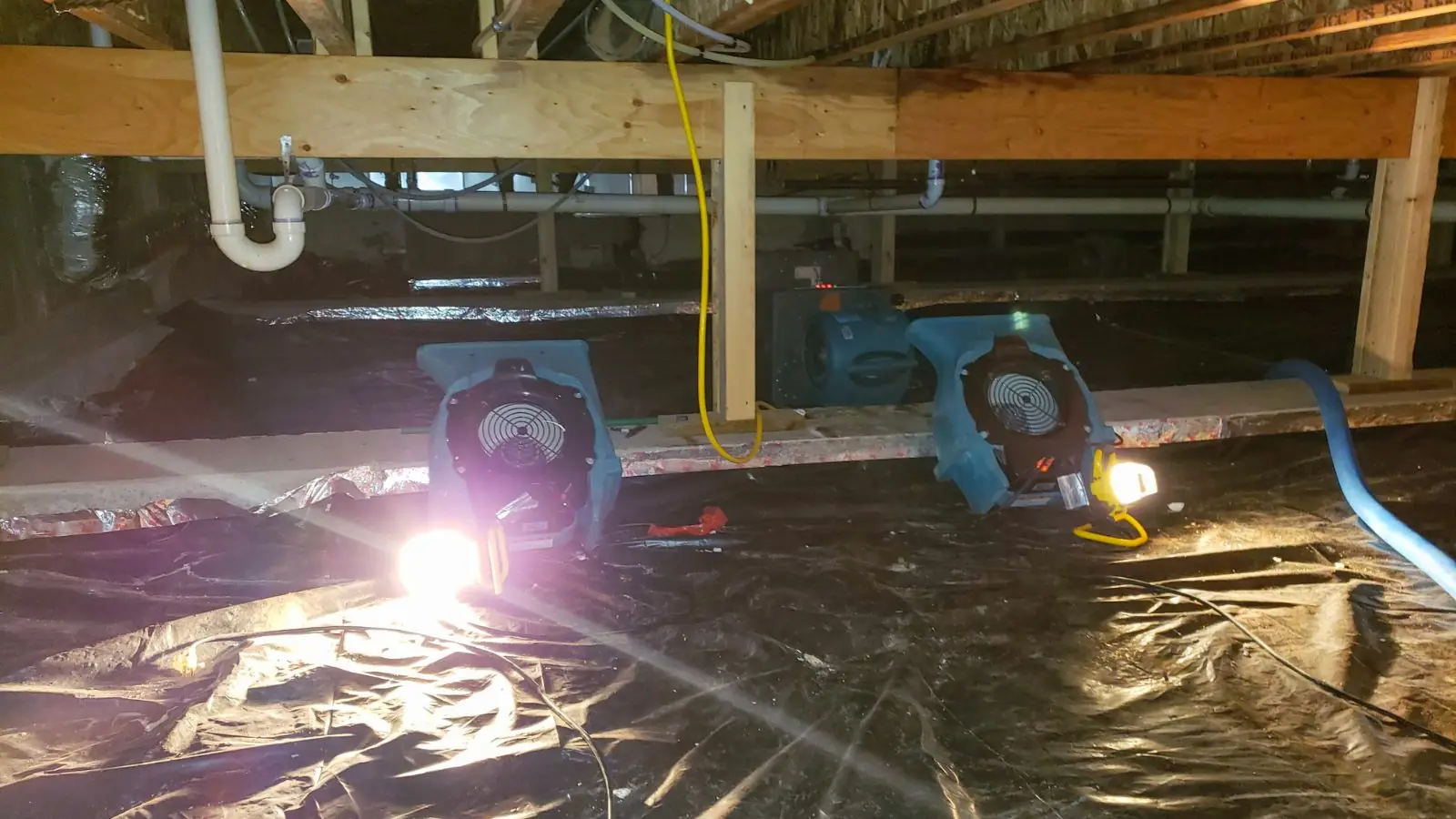
A musty smell at floor level, a bounce in the floor boards, or a plumber who comes up from under the house with wet knees are the usual first hints. Mold in a crawl space is a symptom. The cause is water that arrived and had nowhere to go.
Everything below assumes your home has a raised foundation with an access hatch or a vent opening. If you are not sure, check the exterior for foundation vents near ground level, or look for a small door in a closet floor or along the outside wall.
Where crawl space moisture comes from
Mold needs moisture, organic material and time. Wood framing, subfloor and paper-faced insulation supply the material. Your job, and the job of anyone who inspects the space, is to find the water.
Plumbing leak
A pinhole in a supply line, a loose drain slip joint or a failed shower pan drips onto soil and subfloor. Because it is hidden, it can run for weeks.
Irrigation backflow or broken sprinkler line
A cracked sprinkler riser or a failed backflow device near the foundation can push water toward the vents or under the sill. Look for soggy soil or a lawn patch that stays green along one wall.
Poor drainage
Downspouts that empty beside the foundation, planter beds sloped toward the wall and compacted soil send rain to the same place every winter.
Blocked vents
Foundation vents covered by shrubs, stored boards or stucco patches stop air from moving through. Humid air then settles on cold ducts and framing.
Disturbed vapor barrier
A plastic ground cover that is torn, bunched or missing lets ground moisture rise into the air under your floor.
HVAC condensate
A clogged condensate line or a leaking duct joint can drip steadily onto one spot of subfloor.
Why you should not wander into a wet crawl space
Access is tight, often 18 inches of clearance or less, and a hatch may sit inside a closet or beneath a hallway. Wiring, junction boxes and sometimes low-hanging ductwork share the same space as wet insulation and standing water.
Electrical caution
Do not enter a crawl space where water is touching wiring, outlets or electrical boxes. Cut power only if the panel can be reached on dry ground. Call the utility or 911 for any electrical or gas risk before calling the restoration line. Never enter if sewage is involved.
Loose insulation falls, nails poke through the subfloor and a dropped light leaves you in the dark. If you must look, shine a flashlight from the hatch, photograph what you can see, and stop there.
Damp smell under the floor?
Call (805) 291-8940 and describe what you see from the hatch. Same-day response when available.
What an assessment involves
Find and stop the source
A technician reads moisture meters along the framing, checks the plumbing runs and the irrigation lines, and looks at grading outside. Nothing else works until the water stops.
Map the damp zone
A thermal imaging camera helps trace cold, wet areas on the underside of the floor. Readings are recorded so you can see which joists and subfloor sections are affected.
Set containment
Poly sheeting seals the hatch and any openings into the living space. Negative air machines with HEPA filtration keep disturbed dust from drifting into the house.
Remove what cannot be saved
Wet insulation and badly affected vapor barrier come out first. Contaminated material goes into sealed bags, not into the open yard.
Clean and dry
Framing is HEPA vacuumed and cleaned, then dried with air movers and LGR dehumidifiers until readings meet the target. Antimicrobial treatment follows where the scope calls for it.
Verify
A post-work check confirms moisture is back to normal and the surfaces show no visible growth. Independent testing is an option if a lender or buyer asks for it.
Work of this kind follows ANSI/IICRC S520 practice for mold and S500 practice for the water side. Ask any company whether its crews work to those standards, and ask for the scope in writing before work starts. You can read how the process runs on the mold remediation page.
What gets dried, what gets cleaned, what gets replaced
| Material under the floor | Usual outcome | Reason |
|---|---|---|
| Fiberglass or batt insulation | Replaced | It holds moisture and cannot be cleaned |
| Solid wood joists and beams | Cleaned and dried | Dense wood can usually be HEPA vacuumed and sanded or treated |
| Plywood subfloor with light surface growth | Often cleaned and dried | Structure is checked with a moisture meter first |
| Soft, crumbling or delaminated subfloor | Cut out and replaced | Structural integrity is gone |
| Plastic vapor barrier | Replaced | Easier to install new than to clean a wrinkled sheet |
| Ductwork wrapped in insulation | Case by case | Depends on whether the wrap and seams stayed wet |
Once the space is dry, repairs close the loop. That can mean new insulation, a fresh ground cover, corrected downspout drainage or re-routed sprinkler lines. If wood or drywall was removed from the living area, plan the rebuild through water damage repair.
Prevention is mostly about water leaving the lot
- Extend downspouts several feet from the foundation or tie them to a drain
- Keep soil sloped away from the wall and clear of mulch against vents
- Test sprinklers and check risers for cracks each season
- Look under sinks and the water heater for slow drips, then check the crawl space hatch
- Ask an inspector to open the hatch every year or two
None of this is a promise that moisture will never return. It lowers the odds and, more usefully, makes the next leak visible sooner.
Restoration crews who work in Camarillo and Thousand Oaks see the same underlying causes in raised-foundation homes, so a good scope looks much the same from town to town.
Newbury Park housing notes
Newbury Park includes older and newer neighborhoods. Casa Conejo was the first planned community here, and Ventu Park began as a roughly 500-acre real estate development in the 1940s. Those histories do not tell you how your own house was built, so ask a licensed inspector what foundation type you have and where the access points are.
Arroyo Conejo flows southwest through the community, and a flood-control channel runs along the US 101 corridor. That does not place your address in any zone, so look up your address on FEMA's Flood Map Service Center before you assume that water under your house is a plumbing problem alone.
If the work includes plumbing repair under the house, such as replacing a water or sewer line, the City of Thousand Oaks lists that kind of work among its permit categories. Permit rules vary by scope, so ask the city building department before repair work.
Sources: Wikipedia community history, FEMA Flood Map Service Center, City of Thousand Oaks website
Frequently asked questions
How do I know if my home has a crawl space?
Look for foundation vents near ground level, a small access door on an exterior wall, or a hatch in a closet or hallway floor. Floors that sit a few feet off the soil are another sign.
If you still cannot tell, ask a licensed home inspector or check your property records.
Can I clean crawl space mold myself?
Surface growth on a small area of accessible wood is one thing. A wet crawl space with insulation, wiring and unknown moisture is another. Disturbing growth without containment can spread dust into the living space.
A written assessment tells you whether the job is small or not.
Should I buy a dehumidifier first?
Not before finding the water source. A dehumidifier in a space with an active leak just runs without end. Fix the leak, then dry with proper equipment.
Does insurance cover crawl space mold?
It depends on the policy and on how the moisture arrived. Sudden and accidental water damage is often treated differently from slow seepage, which is often excluded. Ask your insurer, and keep photos and a written scope.
Does living in Casa Conejo or Ventu Park mean I have a crawl space?
No. Both areas have a documented history (Casa Conejo as the first planned community in Newbury Park, Ventu Park as a 1940s development), but neither fact tells you what foundation your house has.
Check for vents and access hatches, then ask an inspector to confirm the foundation type and how to reach the space safely.