
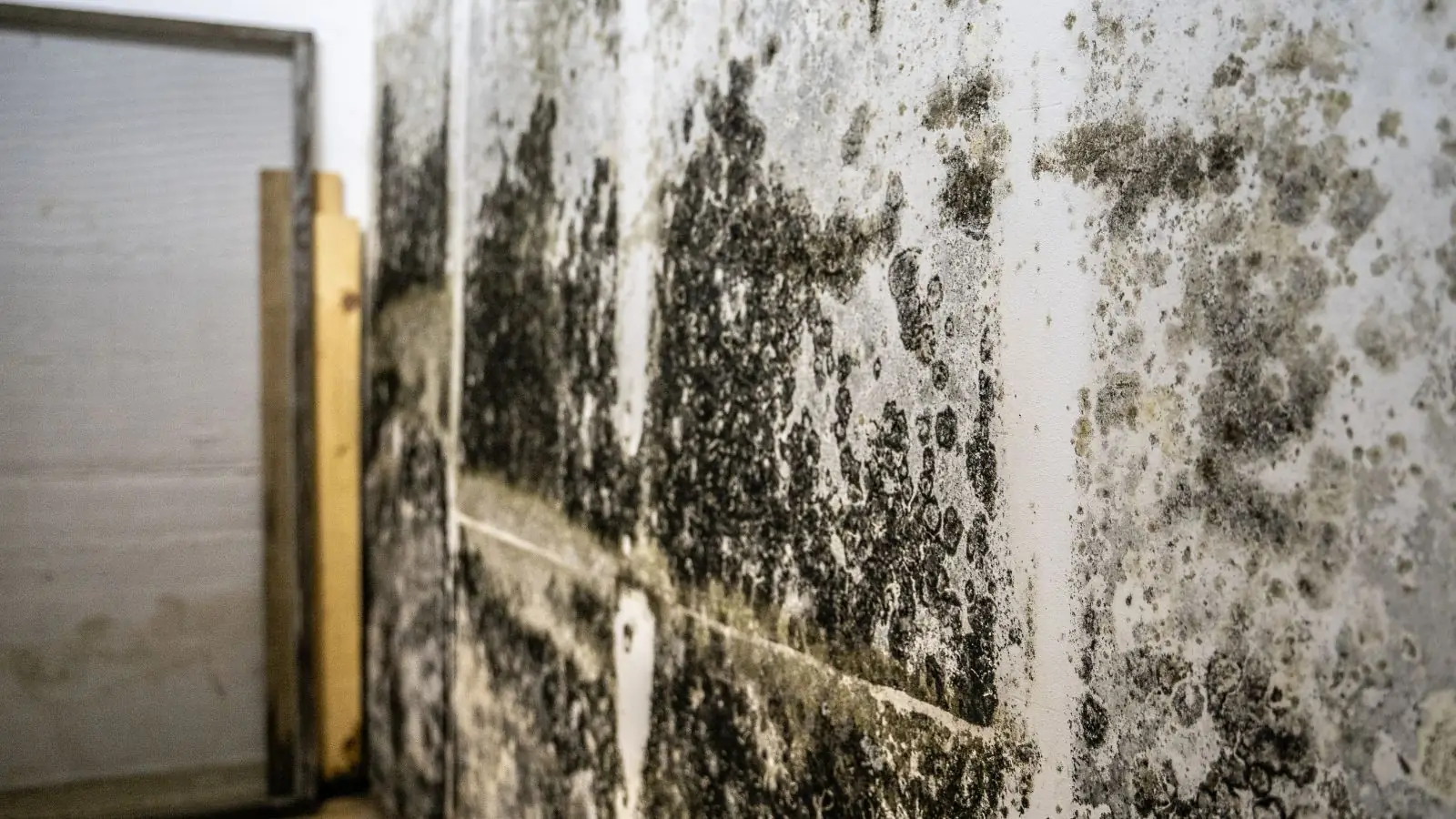
Where mold shows up in lower rooms
What to do before you touch it
Do not dry brush, sweep or sand the growth, because that sends material into the air. Keep the area closed off and do not run the HVAC through the space. Describe the area by phone before you move stored items.
If your home has a basement or a lower level that sits below grade, the walls on the earth side stay cooler and can hold moisture. The same is true of a finished garage, a hillside walkout room or a storage closet against a retaining wall. Mold in these spaces is almost always tied to a source you can name.
Seepage through walls or slab
Groundwater pushing through a foundation wall or floor joint leaves damp paint, white mineral crust and a musty smell. It tends to return after heavy rain.
Plumbing and appliance leaks
A washer supply valve, water heater or irrigation backflow into a low crawl space can soak carpet pad and the bottom of the drywall in a day.
Condensation
Cold concrete meets warm indoor air and sweats. Boxes, couches pushed against walls and closed doors make it worse.
Past flooding never fully dried
A wet-vac and a fan do not dry the cavity behind baseboards. The paper face of drywall stays damp and grows mold behind furniture or inside closets.
Step one is always the water
Cleaning mold off a wall that is still wet is a temporary fix. Industry practice under ANSI/IICRC S520 puts moisture control ahead of any removal, and that means finding the leak, the seepage path or the humidity source and stopping it. A plumber, a grading fix or a dehumidifier may be needed before remediation begins.
A crew will use a moisture meter and a thermal imaging camera to map which materials are wet and how far it goes. That map becomes the written scope. If an estimate skips the moisture readings, ask why.
What the removal sequence looks like
Stop the moisture
Repair the leak, redirect the drainage or fix the ventilation. Active water is dealt with through water mitigation before mold work is scheduled.
Contain the work area
Plastic sheeting seals the room, the doorway gets a zipper entry and the space is put under negative air so dust and spores flow in, not out.
Run HEPA air scrubbers
HEPA air scrubbers filter the air in the contained zone continuously, and exhaust goes outside or through filtration.
Remove porous materials
Carpet, pad, wet drywall, ceiling tile and soaked insulation are cut out, bagged and carried out sealed. Mold roots into these and cannot be wiped off.
Clean the framing and slab
Wood studs and concrete are HEPA vacuumed, wire brushed or sanded as needed, then damp wiped. Antimicrobial treatment follows where the scope calls for it.
Dry and verify
Air movers and LGR dehumidifiers bring the structure to its drying goal. Readings are logged before any rebuild begins.
Musty smell in a lower room?
Call for a moisture check before it spreads to the next wall.
Why bleach and fogging do not solve it
Bleach is mostly water. On porous drywall or wood it can bleach the color out of the surface while the water it carries soaks in, which feeds the problem underneath. It also leaves the fuzzy growth inside the material untouched.
Fogging has the same limit. A fog treatment coats surfaces that are exposed and does nothing to a stud cavity, a carpet tack strip or a wet slab. It also does not remove the dead spores and fragments, and S520 practice relies on physical removal and cleaning. If a company offers fogging as the main fix, ask what gets removed.
What belongs in the written scope
| Item | What it should say | Why ask |
|---|---|---|
| Source of moisture | How it was found and who fixes it | Mold returns if the source stays |
| Containment | Plastic barriers, zipper entry, negative air | Keeps work dust out of the upper floors |
| Materials removed | Square footage of drywall, baseboard, carpet, pad | Sets the cost and the rebuild list |
| Cleaning method | HEPA vacuum, brushing, damp wipe, antimicrobial | Shows how framing is treated, not just wall faces |
| Drying and finish check | Drying goal and readings log | Proves the space is ready to close up |
| Rebuild | Who replaces drywall, flooring and paint | Remediation often ends at bare framing |
After the cleaning: proof and rebuild
When the cleaning and drying are done, the crew checks the space visually and with moisture meters. Some owners, lenders or insurers also ask for independent post-remediation testing, and that is done by a separate party so the company that did the work is not grading itself. Ask whether your state licenses mold work, and who is expected to do the testing.
Only after that does the room get new drywall, flooring and paint. That rebuild work sits with water damage repair, and a good plan lists it up front so you are not surprised by a second contractor.
Safety first
Stay out of any lower room with standing water if an outlet, panel or appliance is in the wet area. Cut power at the breaker only if the panel is dry and reachable, and call the utility or 911 for any electrical or gas risk before calling the restoration line. Questions about how mold affects a person belong with a physician.
Nearby homes, same questions
The process is identical for a hillside home in Oak Park or a lower-level garage conversion in Camarillo. What changes is the source, which is why a site visit with a meter matters more than a quote over the phone. Call (805) 291-8940 and ask for same-day response when available.
Newbury Park water and weather notes
Arroyo Conejo, also called Conejo Creek, flows southwest through Newbury Park, and a flood-control channel runs along the US 101 corridor. Check the FEMA Flood Map Service Center for your address before deciding a lower room only needs a dehumidifier. If your home sits near a channel or creek, ask about drainage as part of the moisture source.
The Conejo Valley has four water purveyors, and the city of Thousand Oaks keeps a Find Your Water Provider map at toaks.gov/waterproviders. If a mold problem began with a hidden supply leak, the bill history is a useful record. Read your bill or use that map to confirm who to call, and keep the documentation for your insurer.
California Department of Insurance guidance says standard homeowners' insurance does not cover flood damage, and groundwater seepage is a different question from a sudden pipe burst. Check your policy or ask your insurer how it treats each.
Sources: Wikipedia, City of Thousand Oaks website, California Department of Insurance
Frequently asked questions
Can I remove basement mold myself?
Small, surface-only spots on non-porous material can sometimes be cleaned by an owner using soap, water and gloves. Anything on drywall, carpet or framing, or larger than a few square feet, usually calls for containment and a trained crew.
Disturbing growth without containment spreads dust into the rest of the house.
Does a dehumidifier alone fix a musty lower level?
It can help control humidity, but it does not remove existing growth or dry a wet wall cavity.
If the smell returns after the dehumidifier runs, there is a source that needs finding.
Why is negative air used?
A fan pulls air out of the contained area so any loose dust and fragments flow toward the filter, not toward the clean rooms.
Without it, cutting out drywall can push debris into the house.
Is mold testing the same as remediation?
No. Testing identifies and measures, while remediation removes and cleans. Many owners keep them separate so the tester has no stake in the scope.
What happens to a finished wall with mold behind it?
The wall is opened, usually by cutting the drywall back past the visible edge, and the framing behind it is cleaned and dried before new board goes up.
Painting over it only hides the surface.
I have a finished garage that floods slightly each winter. Is it a mold risk?
Any room that gets wet and stays damp is a candidate. The Thousand Oaks area averages 17.35 inches of rain a year, mostly in the cool winter months, so repeated seepage shows up in the same season.
Photograph the wall after each storm, check the FEMA flood map for your address and fix the entry path before the next rain.