
Day one starts with a map, not equipment
Before a single machine is unloaded, a technician walks the house with a moisture meter and a thermal imaging camera. Water travels, so the wet area is nearly always bigger than the puddle. Walls pull it up, flooring spreads it sideways and ceilings below a leak catch what drips through.
The readings go onto a sketch of the rooms, with each wet surface marked and a dry reference reading taken from an unaffected part of the home. That reference becomes the finish line. A drying job is complete when wet materials read close to what the same material reads in a dry room.
The equipment, and what each piece is for
| Equipment | What it does | Why it matters |
|---|---|---|
| Moisture meter | Reads moisture inside drywall, wood and subfloor | Gives a number to track instead of a guess |
| Thermal imaging camera | Shows temperature differences behind surfaces | Finds wet areas before any wall is opened |
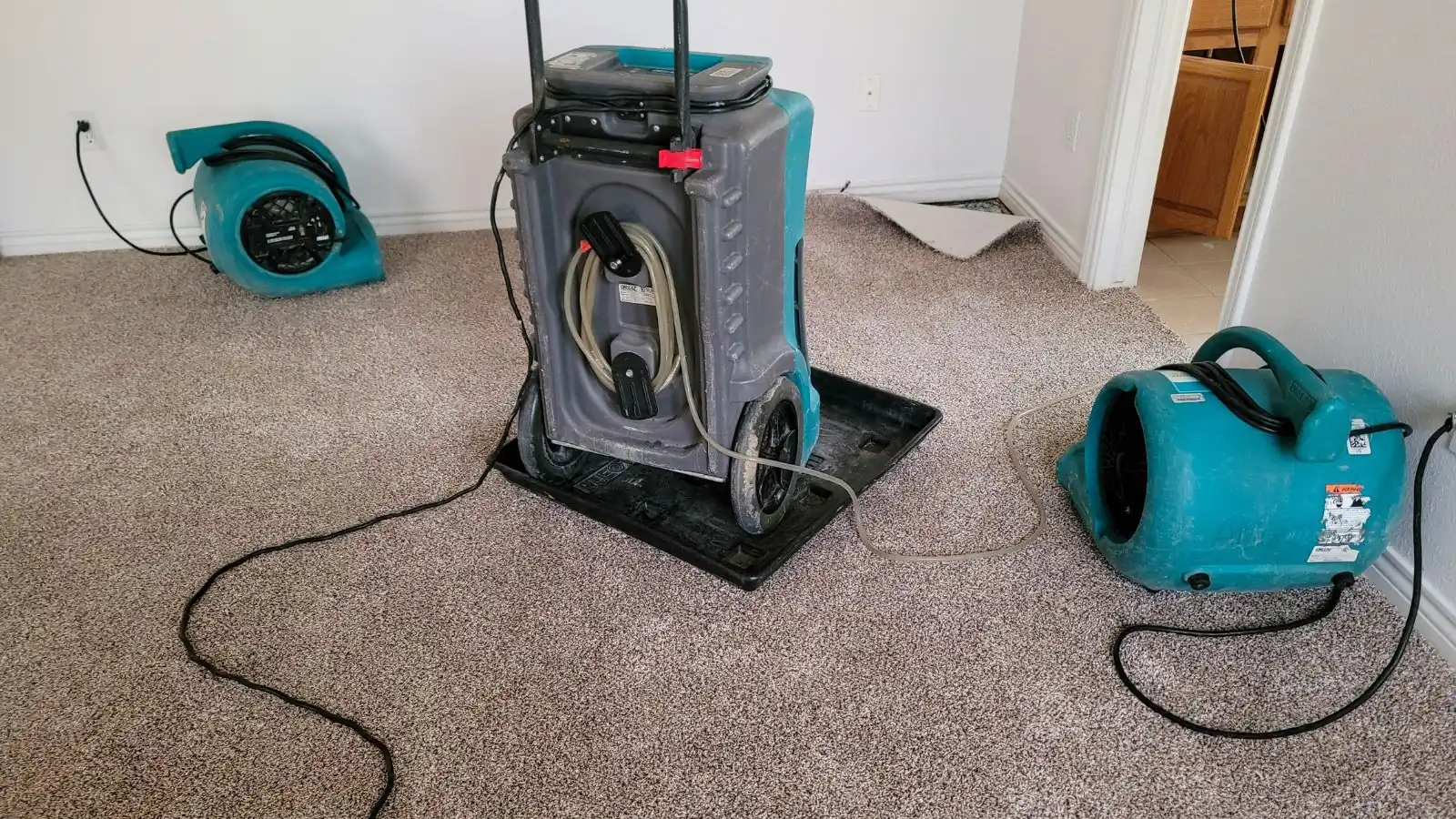
| Air movers | Push dry air across wet surfaces | Speeds evaporation from floors and wall bases |
| LGR dehumidifiers | Pull moisture out of the air | Keep humidity low so surfaces keep releasing water |
| Extraction units | Pull standing water from floors and carpet | Removes the bulk of the water in minutes |
| Containment sheeting | Walls off the wet zone | Stops damp air from spreading to dry rooms |
The dehumidifier is the quiet workhorse. If the air in the room is saturated, wet drywall has nowhere to send its moisture, no matter how many air movers are blowing. Low-grain refrigerant (LGR) units are used because they keep working at higher humidity than basic models.
Containing the wet zone
Drying equipment works best in a closed environment. Crews hang plastic sheeting across a doorway or hallway, close vents in the affected rooms and keep doors shut so the dehumidifiers are not trying to dry the whole house. If the area includes sewage or other contaminated water, containment also keeps that material from spreading, and the scope changes from drying to cleanup under water damage cleanup.
Water on the floor right now?
Call for same-day response when available and ask what the first visit includes.
Why drying takes days, not hours
Water that has soaked into a stud, a subfloor or a plaster layer comes out slowly. Each material gives up moisture at its own pace, and thick or dense materials take longest. Most structural drying runs a few days, and larger or deeper losses can run longer.
That is why technicians come back every day. They record temperature, humidity and moisture readings at the same spots, then adjust. Equipment gets moved, a machine may be added or removed, and a wall that is not responding can be opened. When the readings reach the drying goal, the equipment comes out and not before.
Extract
Standing water comes off first, because every gallon removed by extraction is a gallon the dehumidifiers do not have to handle.
Set up
Air movers go on wet surfaces, dehumidifiers go in the zone and containment goes up around it.
Check daily
Readings are taken and logged each visit. The log is also useful paperwork for an insurance claim.
Adjust
Equipment is repositioned or added based on which areas are lagging.
Verify and release
When wet materials reach their goal, machines are removed and you get a final reading record.
When materials are removed instead of dried
Some materials are cheaper and safer to remove than to dry. Wet carpet pad is almost always discarded. Drywall that has swelled, crumbled or been wet for several days is cut out, and insulation behind it usually goes too. Contaminated water, such as a sewage backup, changes the rule for porous materials altogether.
The removal list should appear in your written scope before demolition starts, with the reason attached to each item. The rebuild afterward, including new board, trim and paint, falls under water damage repair and is usually priced and scheduled separately.
Rental equipment is not the same as a monitored job
Renting air movers and a dehumidifier from a hardware or tool shop can be a reasonable choice for a small, clean spill. But it is a different thing from a drying job where someone maps the moisture, tracks readings daily and decides when the structure is dry. We do not offer rentals, so use these questions with any provider.
- Ask what a rental includes, and whether anyone sets the equipment up.
- Ask who checks the readings, and how often.
- Ask how you will know when the materials are actually dry.
- Ask what the drying goal is for the material, not just for the room.
- Ask for the readings in writing, particularly if your insurer may ask.
For homes near Westlake Village or Oak Park, the process is the same. The equipment on the truck is the same, but your permit contact and water district are different, so confirm both. Our number is (805) 291-8940.
Safety first
Keep out of any room where water has reached an outlet, a panel or an appliance. Cut power at the breaker only if the panel can be reached dry. Call the utility or 911 for any electrical or gas risk before calling the restoration line, and do not run extension cords through standing water.
Newbury Park water and weather notes
The Thousand Oaks area gets about 17.35 inches of rain on average, mostly in the cool winter months, and summers are warm and dry. Drying behaves differently in each season, since dry summer air helps evaporation and a damp winter day slows it. If your loss happens in a wet month, expect a longer drying window and more reliance on dehumidifiers than on opening windows.
The Conejo Valley has four water purveyors, including the City of Thousand Oaks and California American Water, which has an office in Newbury Park. Before you call about a supply failure, read the bill or use the city's Find Your Water Provider map on toaks.gov/waterproviders. That tells you who to ask about shutting off the main or reviewing a usage spike.
Sudden and accidental water damage is often covered and gradual leaks often are not, so always check your policy. Keep the daily drying logs, photos and receipts, since the records help when you ask your insurer how your policy applies.
Sources: Wikipedia citing NOAA normals, City of Thousand Oaks website
Frequently asked questions
How long does structural drying usually take?
Most jobs run a few days. Larger losses, dense materials and wet-season humidity can stretch that.
The number to trust is the moisture reading compared to the dry reference, not a calendar date.
Can I turn the equipment off at night?
Ask the technician first. Stopping the dehumidifiers lets humidity rise and can undo a day of progress.
Machines can be loud, so ask where they can be placed and whether the noise changes after the first night.
Why does my house feel warm and humid during drying?
Dehumidifiers give off heat as they work, and the air near them is drier but warmer. This is normal.
The thermostat should be set per the technician's advice, since air conditioning can help or hinder depending on the setup.
Do crews follow an industry standard?
ANSI/IICRC S500 is the published standard for water damage restoration. Ask any company whether its crews work to it.
Ask also how readings will be recorded and shared.
When does drywall have to be cut out instead of dried?
Usually when it has swelled, softened, crumbled, grown mold or been exposed to contaminated water. Clean water caught early often dries in place.
The deciding factor is the moisture reading plus the condition of the paper face and the joint tape.
Which office handles drywall permits if I am drying a home near the Los Angeles County line?
It depends on the jurisdiction. Westlake Village is a Los Angeles County city, Oak Park is an unincorporated Ventura County community, and the City of Thousand Oaks handles Newbury Park addresses inside city limits.
Ask the city building department or Ventura County building and safety before repair work, because permit rules vary by scope.