
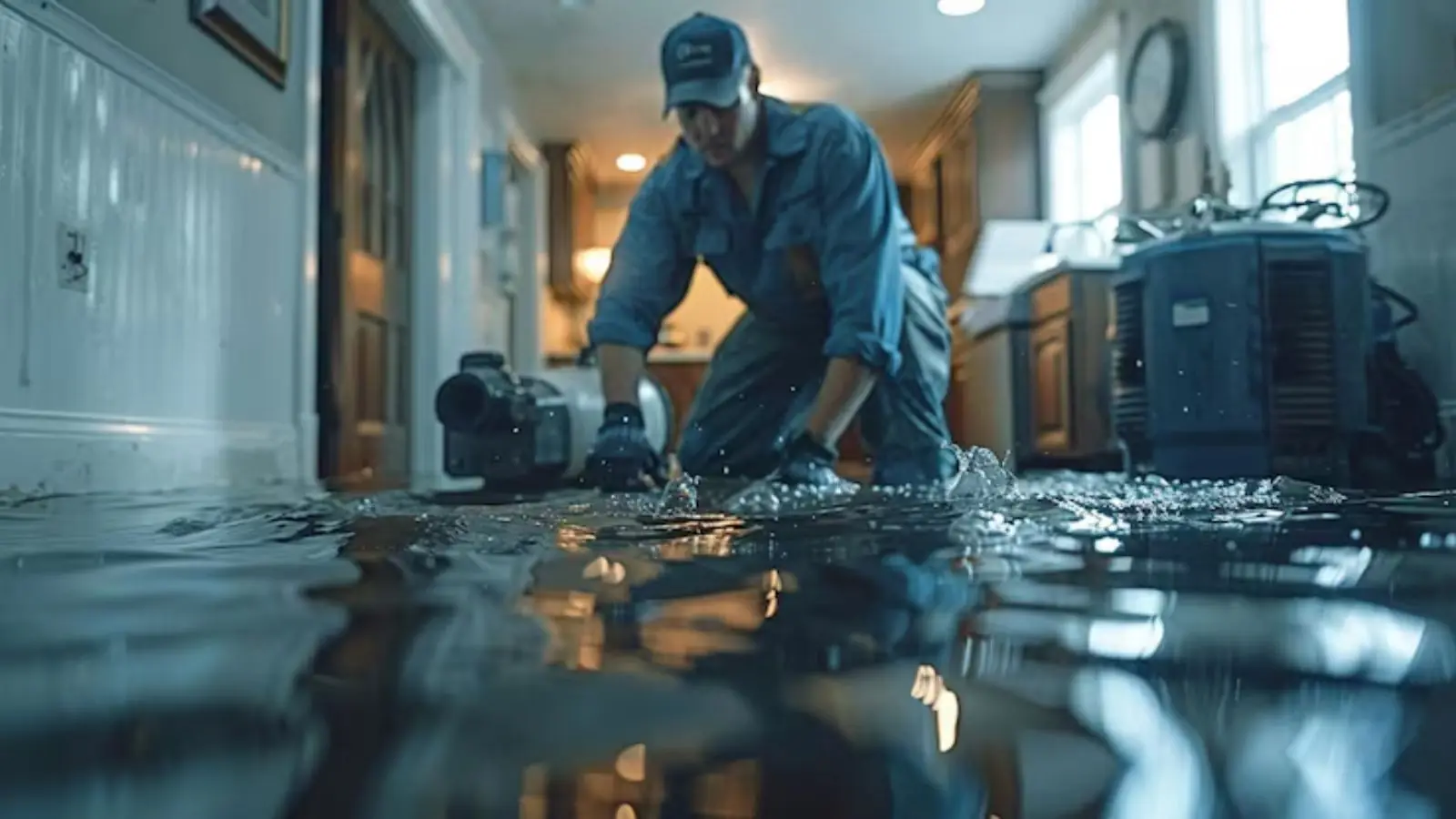
Water damage restoration means stopping the spread of unwanted water, removing it, drying the structure, cleaning what remains and then repairing what could not be saved. That is the whole definition. The details are what separate a job that finishes in a week from one that creeps into hidden mold three weeks later.
The trade follows a published standard, ANSI/IICRC S500, which describes water damage restoration practice. You can ask any company whether its crews work to it. The rest of this page follows the order a typical job moves through.
The job in order
Emergency response and assessment
A technician finds the source, checks safety, and maps moisture with meters and a thermal imaging camera. This is where water is classified and a drying plan takes shape.
Extraction
Standing water comes out first using pumps and truck-mounted or portable extraction units. Removing bulk water early shortens everything that follows.
Controlled drying
Air movers push dry air across wet surfaces while LGR dehumidifiers pull moisture from the air. Readings are logged each visit until materials reach their dry goal.
Cleaning and sanitizing
Salvageable contents and surfaces are cleaned, and antimicrobial treatment is applied where the water category calls for it. Unsalvageable porous items are removed.
Repair and rebuild
Drywall, insulation, flooring, trim and paint are replaced or restored. This stage is often a separate scope from the drying.
People sometimes assume the work is mostly cleanup. In practice, the drying phase is the longest and the most technical. Our water mitigation service covers the first three steps, and water damage cleanup handles the fourth.
Water has a category, and the category sets the rules
S500 sorts water by how contaminated it is at the source, not by how it looks. The category can also worsen over time. Clean water that sits in warm, wet materials for a couple of days can be reclassified as it picks up contaminants.
| Category | Plain-words name | Typical sources | What changes in the work |
|---|---|---|---|
| Category 1 | Clean water | Broken supply line, tub overflow with clean water, rain through a roof | Dry in place, most materials stay |
| Category 2 | Gray water | Washing machine discharge, dishwasher leak, toilet overflow with urine only | Cleaning and antimicrobial added, porous items often removed |
| Category 3 | Black water | Sewage backup, rising floodwater, long-standing wet materials | Containment, removal of porous materials, full sanitizing |
Sewage and electrical
If water is sewage, has reached outlets or the panel, or you see sparking, stay out. Cut power only if the panel can be reached dry. Call 911 or your utility for any electrical or gas risk before you call the restoration line.
Damage classes: how much work is the building holding?
Where category describes the water, class describes how much of the building has absorbed it and how fast it will dry. A class sets how much equipment a crew puts in the room.
| Class | In plain words | Example |
|---|---|---|
| Class 1 | Little moisture, low absorption | A small spill on a tile floor |
| Class 2 | Whole room of carpet and padding, walls wicked up part of the way | A water heater leak across a bedroom |
| Class 3 | Water came from above, so ceilings, walls and floor are wet | Supply line failure in an upper floor |
| Class 4 | Deep saturation of dense materials like hardwood, plaster or concrete | Long-term seep under a slab or a hardwood floor |
Water in the house right now?
Call the restoration line. Same-day response when available, any hour.
Who does what
A water loss usually involves four different roles, and confusion about them delays the repair. Each handles one slice.
Restoration company
Stops the spread, extracts, dries, cleans, documents conditions with photos and moisture logs, and often scopes the rebuild.
Plumber
Finds and repairs the failed pipe, fixture, water heater or drain. Restoration crews usually do not repair plumbing.
General contractor
Handles larger rebuilds such as new framing, cabinets and flooring, or coordinates trades after the drying is done.
Insurance adjuster
Reviews the loss under your policy and decides what the claim covers. You are the one who makes the claim, and the adjuster is the one who evaluates it.
Documentation ties these roles together. Photos, drying logs and a written scope all help support a claim. Sudden and accidental water damage is often covered, and gradual leaks and neglect often are not, so check your policy or ask your insurer before assuming.
Where the rebuild fits
Restoration ends where reconstruction begins, though some companies do both. Once readings confirm that framing and subfloor are dry, the repair stage replaces drywall, flooring and finishes. Our water damage repair service covers that work for homes already through the drying stage.
Homes across the Conejo Valley follow the same sequence. Crews serving Thousand Oaks and Camarillo use the same categories, classes and logs, even though the neighborhoods differ.
Signs a restoration plan is thin
- No moisture readings are taken, only a visual look.
- Equipment is placed once and never checked again.
- The water category is never named.
- Wet porous materials are left in place after sewage or long-standing water.
- Drying ends on a calendar date rather than on a reading.
Newbury Park water and weather notes
Arroyo Conejo, also called Conejo Creek, is the principal waterway through Newbury Park and flows southwest through the community. A flood-control channel runs along the US 101 corridor, so look up your address on FEMA's Flood Map Service Center. If your house sits near that corridor, that lookup tells you whether to ask about flood coverage before the next storm instead of after it.
The California Department of Insurance states that standard homeowners' insurance does not cover flood damage. NFIP policies generally take effect 30 days after purchase, so waiting until rain is forecast is too late. The rain itself matters, since the Thousand Oaks area averages 17.35 inches a year, mostly in the cool winter months.
Four water purveyors serve the Conejo Valley, so the office to call about a main-line break depends on your address. Read your water bill or use the city's Find Your Water Provider map. Shutting off the water at your meter is the first step for a failed main.
Sources: Wikipedia, California Department of Insurance, City of Thousand Oaks website
Frequently asked questions
What does water damage restoration include?
Assessment, water extraction, structural drying, cleaning and sanitizing, and repair or rebuild. Some jobs stop after drying and others continue into reconstruction.
The scope should say which of these stages you are buying.
How long does drying take?
It depends on the class, the materials and the equipment placed. Many jobs run several days, and dense materials like hardwood and plaster take longer. Drying is complete when readings reach the dry goal, not when a set number of days passes.
What is the difference between mitigation and restoration?
Mitigation is the emergency phase: stopping damage from growing by extracting and drying. Restoration is the broader term that also includes cleaning and repair.
Some people use the words interchangeably, so ask what a quote includes.
Can I dry the house myself with fans?
Household fans move air but do not control humidity, and they cannot see inside walls. Hidden moisture can stay in framing and insulation. A meter reading is the only way to know materials are dry.
Does my homeowners policy cover creek or channel flooding near Newbury Park?
The California Department of Insurance states that standard homeowners' insurance does not cover flood damage. Flood usually needs its own policy through the National Flood Insurance Program or a private insurer.
Ask your insurer what your policy excludes, and check the FEMA Flood Map Service Center for your address.